


Use GitHub Actions workflow commands from Python: annotate logs, share values between steps, read inputs, and write job summaries.
Python 3.11+ · Linux, Windows, macOS · No runtime dependencies · Typed
Note
See the changelog for breaking changes and upgrade instructions.
Contents
Install · Quick start · Logging · Groups and command control · Step data · Inputs · Environment and events · Action state · Artifact identities · Configuration · Development
python -m pip install github-action-utilsOr add it to a uv project:
uv add github-action-utilsCreate .github/workflows/demo.yaml:
name: Python workflow commands
on: workflow_dispatch

permissions:
  contents: read

jobs:
  demo:
    runs-on: ubuntu-latest
    steps:
      - uses: actions/setup-python@5fda3b95a4ea91299a34e894583c3862153e4b97 # v7
        with:
          python-version: '3.15'
      - run: python -m pip install github-action-utils
      - name: Prepare a result
        id: prepare
        shell: python
        run: |
          import github_action_utils as gha

          with gha.group("Build"):
              gha.notice("Build complete")
              gha.set_output("version", "1.0.0")
              gha.set_env("PACKAGE_NAME", "demo")
              gha.append_job_summary("## Build\n\nVersion: **1.0.0**")
      - name: Use the result in a later step
        env:
          BUILD_VERSION: ${{ steps.prepare.outputs.version }}
        run: |
          printf '%s %s\n' "$PACKAGE_NAME" "$BUILD_VERSION"
The examples below use import github_action_utils as gha.

| Function | Result |
|---|---|
echo(message) |
Print ordinary text. |
debug(message) |
Emit a debug message; enable step debug logging to see it. |
notice(message, ...) |
Create a notice annotation. |
warning(message, ...) |
Create a warning annotation. |
error(message, ...) |
Create an error annotation and return normally. |
fail(message) |
Emit an error and exit immediately with status 1. |
set_command_echo(enabled) |
Enable or disable the runner's command diagnostics; accepts a bool. |
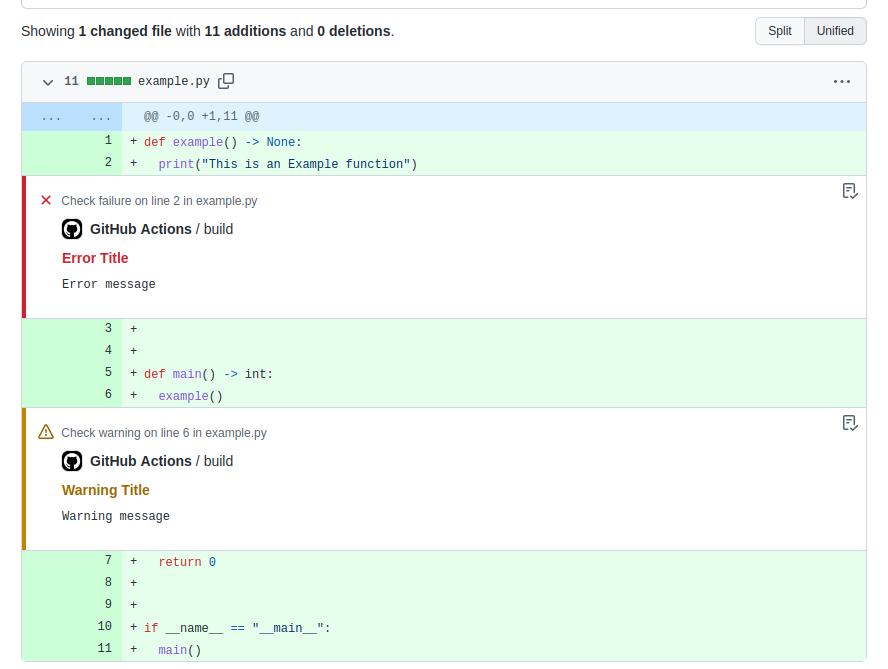
notice, warning, and error accept the same optional annotation properties:
title, file, col, end_column, line, and end_line.
gha.echo("Starting build")
gha.debug("Checking dependencies")
gha.warning("Unused variable", title="Lint", file="src/app.py", line=12, col=5)
gha.notice("Review this block", file="src/app.py", line=20, end_line=24)
Use columns for a single line; GitHub drops column properties for annotations spanning multiple lines. Pass normal text—command helpers handle escaping. See the workflow command reference.
with gha.group("Run checks"):
    gha.echo("Checking formatting")
    gha.echo("Checking types")
The group closes even if the body raises. For manual control, use
start_group(title) and end_group().

gha.add_mask("example-secret-value")
gha.echo("example-secret-value")  # GitHub displays the registered value as ***.
Register masks before printing sensitive values.
echo() prints raw text, so command-looking text can be interpreted by GitHub.
Use stop_commands() when printing text that should stay literal:
with gha.stop_commands():
    gha.echo("::warning::This remains plain text")
Processing resumes even if the body raises. For manual control:
token = gha.begin_stop_commands()
try:
    gha.echo("::error::Also plain text")
finally:
    gha.end_stop_commands(token)
stop_commands(token=None) and begin_stop_commands(token=None) generate random
UUID4 tokens by default. Custom tokens must be unique for the run; prefer the
generated token.
Problem matchers turn matching tool output into annotations.
gha.add_problem_matcher(".github/matchers/compiler.json")
try:
    gha.echo("src/app.py:12: Unused variable")
finally:
    gha.remove_problem_matcher(owner="compiler")
remove_problem_matcher(*, owner=None, path=None) requires exactly one
selector. Use path=".github/matchers/compiler.json" to remove matchers from a file.
Relative matcher paths resolve against the workspace.
Example matcher file: .github/matchers/compiler.json
{
  "problemMatcher": [{
    "owner": "compiler",
    "severity": "warning",
    "pattern": [{
      "regexp": "^(.+):([0-9]+): (.+)$",
      "file": 1,
      "line": 2,
      "message": 3
    }]
  }]
}
See GitHub's problem matcher guide.
| Function | Behavior |
|---|---|
set_output(name, value) |
Set an output for later steps using the producing step's id. |
set_env(name, value) |
Set an environment variable for later steps in the same job. |
get_env(name) |
Read the process environment first, then the current step's pending environment file. Missing values return None; an empty process value takes precedence. |
get_workflow_environment_variables() |
Read pending values from this step's GITHUB_ENV file. Returns a fresh dictionary, or {} when the path is unset/empty. |
gha.set_output("files", ["app.whl", "app.tar.gz"])
gha.set_env("BUILD_MESSAGE", "First line\nSecond line: 100%")

pending = gha.get_workflow_environment_variables()
message = gha.get_env("BUILD_MESSAGE")
Lists, tuples, and dictionaries become JSON; other values use str(). File
values preserve Unicode, whitespace, percent signs, and line breaks. Use nonempty
string names without =, <<, CR, LF, or NUL.
Scope: set_env() does not change this Python process's os.environ or
gha.vars. The pending file contains only this step's queued variables. GitHub
protects GITHUB_*/RUNNER_* variables and blocks NODE_OPTIONS through GITHUB_ENV.
from pathlib import Path

gha.add_system_path(Path.cwd() / "tools", strict=True)
add_system_path(path, *, strict=False) accepts strings and text PathLike
objects. Directories become available in later steps; the current process's
PATH stays unchanged. A directory need not exist yet. strict=True requires one
nonempty entry without CR, LF, or NUL. The default preserves legacy path batches;
NUL is always rejected.
| Function | Behavior |
|---|---|
append_job_summary(markdown_text) |
Append Markdown and a newline. |
overwrite_job_summary(markdown_text) |
Replace this step's summary with Markdown and a newline. |
remove_job_summary() |
Delete this step's summary; a missing file is harmless. |
gha.append_job_summary(
    "## Results\n\n| Check | Result |\n| --- | --- |\n| Tests | Passed |"
)
Markdown is written as raw UTF-8. Replacement and deletion affect the current step's summary. GitHub summary documentation

These helpers read INPUT_* environment variables:
| Function | Missing optional input | Defaults |
|---|---|---|
get_user_input(name, ...) |
None |
required=False, trim_whitespace=False |
get_boolean_input(name, ...) |
None |
required=False, trim_whitespace=True |
get_multiline_input(name, ...) |
[] |
required=False, trim_whitespace=True, keep_empty_lines=False |
target = gha.get_user_input("target", required=True, trim_whitespace=True)
enabled = gha.get_boolean_input("enabled")
files = gha.get_multiline_input("files", required=True)
raw_lines = gha.get_multiline_input(
    "template", trim_whitespace=False, keep_empty_lines=True
)- Raw: preserves empty strings and whitespace unless trimming is enabled.
- Boolean: accepts
true/True/TRUEandfalse/False/FALSE. Empty strings and other spellings raiseValueError. - Multiline: splits LF/CRLF, optionally trims each line, and optionally keeps empty lines—including a final empty line after a terminal newline.
- Required: raises
ValueErrorfor missing/empty input after the selected trimming. Multiline input needs at least one nonempty line.
Names are uppercased; spaces fall back to underscores and hyphens are preserved. For composite actions and workflow inputs, wire values explicitly:
- name: Read inputs
  env:
    INPUT_TARGET: ${{ inputs.target }}
run: python script.pyif gha.is_github_action():
gha.notice("Running in GitHub Actions")
else:
print("Running locally")Detection checks GITHUB_ACTIONS == "true" on every call. File-writing helpers
need their runner-provided file paths; missing paths raise KeyError and file
errors propagate.
print(gha.vars.github.repository)  # str or None
print(gha.vars.github.run_number)  # str or None; numbers stay strings
print(gha.vars.runner.os)  # str or None
print(gha.vars.runner.debug)  # bool
vars reads os.environ on access. Properties are read-only; missing text is
None and empty text stays "". Boolean flags use exact values:
| Property | True when |
|---|---|
vars.ci, vars.github.actions, vars.github.ref_protected |
The corresponding environment value is "true". |
vars.runner.debug |
RUNNER_DEBUG is "1". |
The public classes WorkflowVariables, GitHubVariables, and RunnerVariables
can also be used as type annotations or instantiated as separate views.
All environment properties
Property names map to their uppercase environment names: for example,
vars.github.run_id reads GITHUB_RUN_ID and vars.runner.tool_cache reads
RUNNER_TOOL_CACHE.
| View | Properties |
|---|---|
vars |
ci, github, runner |
vars.github — action |
action, action_path, action_repository, job |
vars.github — identity |
actor, actor_id, triggering_actor, repository, repository_id, repository_owner, repository_owner_id |
vars.github — run |
actions, workflow, workflow_ref, workflow_sha, run_id, run_number, run_attempt, retention_days |
vars.github — refs and events |
ref, ref_name, ref_type, ref_protected, base_ref, head_ref, sha, event_name, event_path |
vars.github — URLs and files |
api_url, graphql_url, server_url, workspace, env, output, path, step_summary, artifacts, artifacts_list |
vars.runner |
arch, environment, name, os, temp, tool_cache, debug |
This Python view is separate from GitHub's workflow-expression
vars context,
which holds configuration variables. Import it explicitly (gha.vars or
from github_action_utils import vars); wildcard imports preserve built-in vars().
payload = gha.event_payload()
print(payload.get("action"))

gha.event_payload.cache_clear()  # Reload on the next call.
event_payload() loads UTF-8 JSON from GITHUB_EVENT_PATH and caches the result.
Calls share the same mutable object. Use .cache_info() for cache statistics.
| Function | Behavior |
|---|---|
save_state(name, value) |
Save a value for another lifecycle hook of the same action. |
get_state(name) |
Read STATE_<name> in the receiving hook; returns None when absent. |
In the action's main hook:
gha.save_state("cleanup_path", "/tmp/build")In its post hook:
cleanup_path = gha.get_state("cleanup_path")State uses the same value conversion as step data. It is scoped to an action's pre/main/post lifecycle. Local actions support main/post hooks. Use outputs or environment variables to share values between ordinary steps. GitHub state documentation
Important
These APIs need the runner's conditional artifact-file feature. Exposed file paths alone do not prove support. Declarations record identities; they do not upload files, push images, or sign artifacts.
| Function or type | Behavior |
|---|---|
declare_file_artifact(path) |
Queue a plain file path. The runner resolves relative paths against the workspace and computes its identity after the step. |
declare_oci_artifact(reference) |
Queue an OCI reference with a full sha256, sha384, or sha512 digest (64, 96, or 128 hex characters). An oci:// prefix is optional; digest hex is normalized to lowercase. |
get_workflow_artifacts() |
Read fresh version-1 metadata as a tuple of immutable ArtifactSubject values. An empty subjects list returns (). |
ArtifactSubject(name, digest, kind) |
A named tuple with name, digest (algorithm:hex), and kind ("file" or "oci"). |
On a supported runner:
gha.declare_file_artifact("dist/app.whl")
gha.declare_oci_artifact(
    "ghcr.io/example/app@sha256:" + "a" * 64
)  # Use your image's real digest.
In a later step:
for subject in gha.get_workflow_artifacts():
    print(subject.name, subject.digest, subject.kind)
Missing artifact-file configuration raises RuntimeError; empty/malformed or
unsupported metadata raises ValueError. File errors propagate. See GitHub's
artifact command documentation.
Console helpers accept use_subprocess=False. To emit a message through a child
Python process without invoking a shell:
gha.echo("Hello", use_subprocess=True)Set gha.COMMANDS_USE_SUBPROCESS = True for all console helpers. The global flag
wins over a per-call False. The COMMANDS_USE_SUBPROCESS environment variable is
read once at import: any nonempty string enables it, including "false" and
"0". Set the module flag to False to disable that global setting.
Compatibility and validation details
- Python 3.11+ is required. Existing 1.1.0 package functions and call signatures remain available. See the upgrade notes for behavior changes.
- The old boolean
use_subprocessargument onset_output()andsave_state()emitsDeprecationWarning; both helpers always write runner files. - Pending environment reads accept simple and multiline records, including a
leading UTF-8 BOM. Later duplicate names win; malformed records raise
ValueError. - File-command names are validated before writing. Artifact declarations also
reject CR/LF/NUL,
=, and trailing whitespace. - Custom stop tokens reject literal spaces, CR/LF/NUL,
::, trailing:, and reserved workflow-command names. Invalid tokens are rejected before emission. CommandTypesandLogCommandTypesare public typing aliases.COMMAND_MARKERand the legacyACTION_ENV_DELIMITERremain available; file writers generate their own collision-checked delimiters.
Development uses Python 3.15, uv, Ruff, strict mypy, pytest, and tox. CI covers Python 3.11–3.15 on Linux, Windows, and macOS. The feature showcase demonstrates every public function, with automated checks, manual display checks, and conditional skips.
See CONTRIBUTING.md for setup, testing, and releases; open an issue for bugs. Licensed under MIT.