
Use a Muse Code subscription in opencode. Muse models appear in
the model picker as the muse provider, and requests go through the signed-in muse
CLI, so no Muse credential reaches opencode or your config.
Tested with Muse CLI 1.4.23 and opencode 2.3.2. Republished build of
@rasyid_rafi/opencode-muse
with two patches: CREDITS.md has the diff, docs/provenance.md the
build hash and what it does and does not prove.
Not affiliated with Meta or opencode. Best-effort maintenance by one person, with no support commitment.
- registers the
museprovider (labelled "Muse Code") withmuse-ember-1.0,muse-wonder-1.0,muse-spark-1.3, andmuse-spark-1.2, usable as a main or subagent model - implements
LanguageModelV3, translating opencode turns into Muse CLI sessions - runs a loopback-only MCP server (
127.0.0.1, random port, per-start bearer token) so Muse can call opencode's tools - forwards
museAgentandmuseInstructionsoptions
Muse Code authenticates in its own CLI. Meta attests the Muse Code client: a subscription
covers requests that client makes, and api.meta.ai refuses requests carrying a
subscription key from anything else (permission_error,
code: client_attestation_denied). So the plugin drives the signed-in CLI (muse serve,
via @muse-code/sdk) instead of calling the model API itself. It never holds Muse
credentials, and the API key it reports to opencode is a placeholder that is never sent
to Muse.
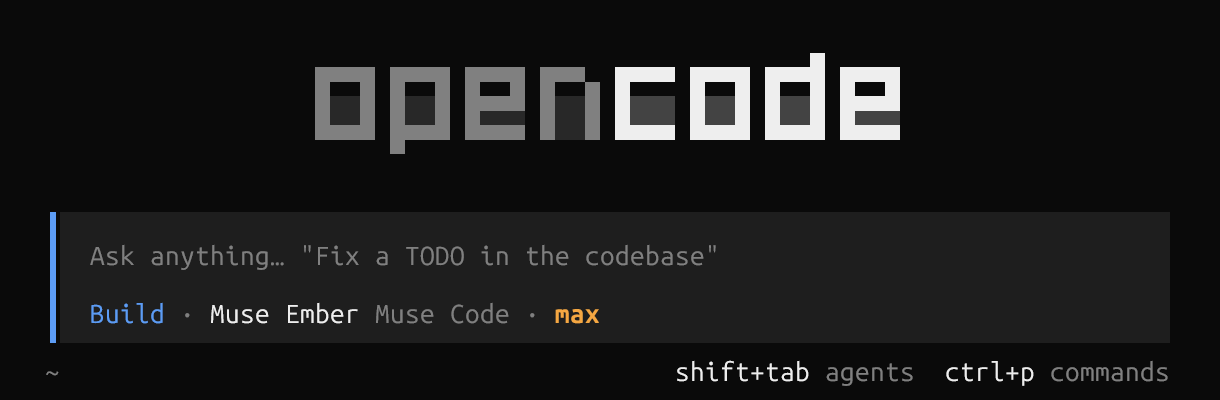
One turn end to end. opencode draws the model label, the latency, and the throughput from the provider, so the line under the reply is the plugin reporting back:

opencode plugin add @jonathand34/opencode-plugin-museIf that fails (some opencode builds currently error in their embedded installer with
NpmInstallFailedError), install the package yourself and point a plugin file at it,
which is what opencode loads:
// ~/.config/opencode/plugins/muse.js
export { default } from "@jonathand34/opencode-plugin-muse";
Requirements: opencode 2.x (the plugin targets the V2 plugin API in
@opencode/plugin); Muse Code CLI 1.4.20 or newer, already logged in; Node >= 22 for
the build and bun >= 1.4.4 for the tests. Runtime dependencies are
@ai-sdk/provider@3.0.8, @muse-code/sdk@1.4.15, and @opencode/plugin@2.2.7.
If the CLI is missing or signed out, model discovery fails and the provider has no
models; the plugin logs model discovery failed with the reason.
bash scripts/repro.shIt installs from the committed lockfile, compiles, and compares the resulting dist/
against the hash recorded in docs/provenance.md. It prints PASS or exits non-zero.
npm run check:offline # typecheck plus the offline test suitenpm run check:offline runs 32 tests that need no network or credentials. bun test
adds five suites (tool-bridge, fork-live, model-live, conformance, restart-live)
that spawn a real muse serve host: 38 tests in total, all needing a logged-in Muse Code
CLI. One reuses a tool result on the next turn; another resumes a session after its host
has been restarted.
Those live suites pass contributorMode: "off" for the same reason the plugin does.
The empty preset turns contributor mode on, which routes every model to its
-contributor variant, and muse-ember-1.0 has none, so the model request fails with
code: "modelError" unless the flag is set.
The npm package is built and published by .github/workflows/publish.yml on
GitHub Actions, and every version carries a provenance attestation. After
installing, two checks tie the bytes you have to that workflow:
npm audit signatures # registry signatures and attestationsTo match the tarball against the attestation yourself, compare the two digests. The registry reports base64, the attestation reports hex:
npm view @jonathand34/opencode-plugin-muse@0.1.10 dist.integrity

curl -sS -A npm/11.19.1 \
  "https://registry.npmjs.org/-/npm/v1/attestations/@jonathand34%2fopencode-plugin-muse@0.1.10" \
  | jq -r '.attestations[] | select(.predicateType=="https://slsa.dev/provenance/v1")
      | .bundle.dsseEnvelope.payload' \
  | base64 -d | jq -r '.subject[0].digest.sha512'
What the attestation establishes: the tarball was built by this repository's
publish.yml at refs/heads/main on a GitHub-hosted runner, and it names the
workflow run. That is SLSA Build Level 2 — it shows where the bytes came from,
not that they are free of bugs. The plugin never holds credentials; it drives
the signed-in muse CLI.
The attestation endpoint needs an npm-style User-Agent. A bare curl gets a
404.
src/        upstream source plus the two patches in docs/provenance.md
test/       upstream test suite
docs/       provenance record
evidence/   inputs for the reproduction check (diffs, measurements); repository only
scripts/    repro.sh, check.sh
MIT, same as upstream. See LICENSE and CREDITS.md.