







This is a pytest plugin that helps you test code that relies on a running MongoDB database. It provides fixtures for a MongoDB process and client.
Runtime requirements are defined in pyproject.toml.
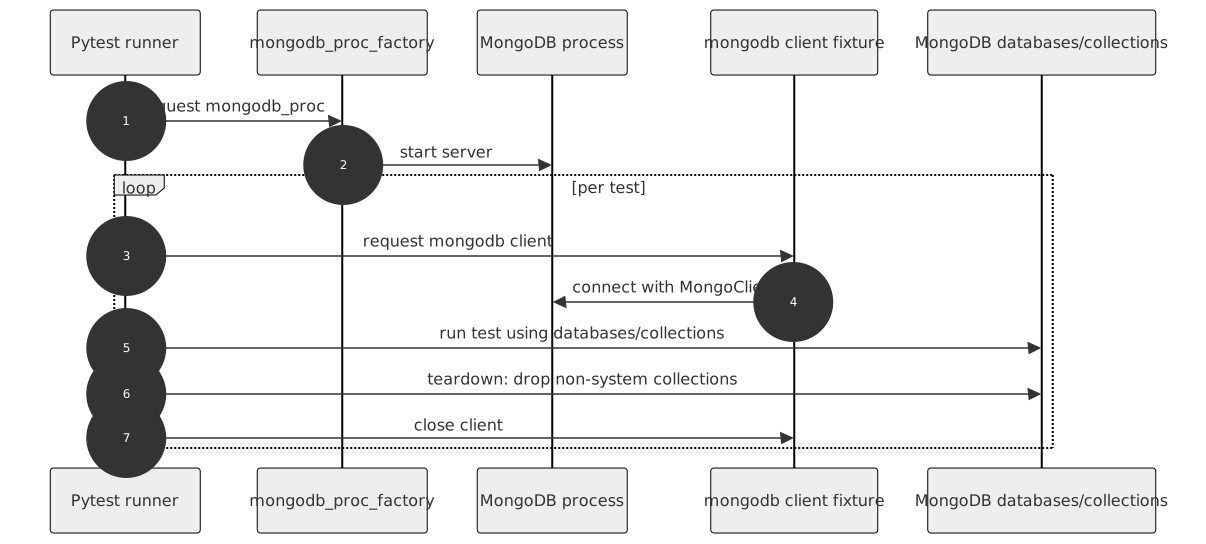
The plugin contains three fixtures:
- mongodb - a function-scoped client fixture that cleans MongoDB at the end of each test.
- mongo_proc - a session-scoped fixture that starts a MongoDB instance on first use and stops it at the end of the test session.
- mongo_noproc - a no-process fixture that connects to an already running MongoDB instance. For example, on dockerized test environments or CI providing MongoDB services.
Simply include one of these fixtures in your test or fixture list.
Both mongo_proc and mongo_noproc support authentication via the username,
password, and auth_source arguments. When username is passed to mongo_proc,
mongod is started with --auth and the user is created via the MongoDB localhost
exception, so subsequent connections authenticate with that account. The mongo_noproc
fixture additionally accepts tls and a full uri for connecting to existing servers.
You can also create additional MongoDB client and process fixtures if you need to:
from pytest_mongo import factories

mongo_my_proc = factories.mongo_proc(port=None)
mongo_my = factories.mongodb('mongo_my_proc')
Note
Each MongoDB process fixture can be configured in a different way than the others through the fixture factory arguments.
Some projects use already running MongoDB servers (e.g., on docker instances).
To connect to them, use the mongo_noproc fixture.
mongo_external = factories.mongodb('mongo_noproc')By default, the mongo_noproc fixture connects to a MongoDB instance on port 27017.
Standard configuration options apply to it.
The mongo_noproc fixture also supports authenticated and TLS connections, as well as
connecting via a full connection URI:
mongo_auth_proc = factories.mongo_noproc(
    host="mongo.example.com",
    port=27017,
    username="user",
    password="secret",
    auth_source="admin",
    tls=True,
)
mongo_auth = factories.mongodb("mongo_auth_proc")
When uri is provided, it takes precedence over the host/port/credential arguments:
mongo_uri_proc = factories.mongo_noproc(
    uri="mongodb://<user>:<password>@mongo.example.com:27017/?authSource=admin"
)Factory arguments and settings are fixed before the tests start. When the server's
address is chosen during the session, such as a container on a free port, write your own
session-scoped process fixture and pass its name to factories.mongodb. Any object with
host and port attributes works, so a mirakuru executor can both start the
container and serve as the process fixture:
import subprocess

import pytest
from mirakuru import TCPExecutor
from port_for import select_random

from pytest_mongo import factories


@pytest.fixture(scope="session")
def mongo_docker():
    port = select_random()
    name = f"pytest-mongo-{port}"
    executor = TCPExecutor(
        ["docker", "run", "--rm", "--name", name,
         "-p", f"127.0.0.1:{port}:27017", "mongo:8.0"],
        host="127.0.0.1",
        port=port,
        timeout=60,
        stdout=subprocess.DEVNULL,
    )
    try:
        with executor:
            yield executor
    finally:
        subprocess.run(["docker", "rm", "-f", name], capture_output=True)


mongo_in_docker = factories.mongodb("mongo_docker")
stdout=subprocess.DEVNULL discards the server's log output, which would otherwise
fill mirakuru's unread pipe and stall the container. When the server is not ready within
the timeout, mirakuru kills docker run without stopping the container, so the
finally block removes it by name. Pull the image beforehand, or the download counts
towards the timeout.
When another fixture already supplies the address, return a MongoNoopExecutor from
pytest_mongo.executor_noop instead. The mongodb client fixture also reads
username, password, auth_source, uri and tls from the process fixture
when present, and MongoNoopExecutor accepts all of them.
Transactions and change streams need a replica set or a sharded cluster, and a standalone MongoDB server rejects them. A single-member replica set running in Docker is enough for tests. Start the container with a replica set name, then initiate the set once:
docker run -d --name mongo-rs -p 127.0.0.1:27017:27017 mongo:8.0 --replSet rs0 --bind_ip_all
docker exec mongo-rs mongosh --quiet --eval \
    'rs.initiate({_id: "rs0", members: [{_id: 0, host: "localhost:27017"}]})'
rs.initiate fails while mongod is still starting, so retry it a limited number of
times and fail the setup if it never succeeds. In Docker Compose or CI, run it as its own
step once the container has started, and keep the health check for readiness only.
Connect to the set through mongo_noproc with a URI naming the replica set:
mongo_rs = factories.mongodb("mongo_noproc")[pytest]
mongo_uri = mongodb://127.0.0.1:27017/?replicaSet=rs0&directConnection=truedirectConnection=true keeps the client on the address in the URI. Without it, the
client switches to the member address stored in the replica set configuration, which is
the container's own view of itself and is not reachable when the container port is mapped
to a different port on the host.
The mongodb fixture manages one database - test by default - and empties it at
the end of each test by dropping its non-system.* collections. Nothing else on the
instance is touched, so preseeded data survives and tests running in parallel against a
shared MongoDB instance do not clear each other's databases.
Point the fixture at a different database with dbname:
from pytest_mongo import factories

mongo_my = factories.mongodb("mongo_proc", dbname="orders")
A single MongoClient can reach every database on the server, so one test may
legitimately use several. Name the further ones in dbs and they are managed
alongside dbname:
mongo_my = factories.mongodb("mongo_proc", dbname="orders", dbs=["customers"])dbs is optional, and dbname on its own is enough for most suites. Collections
are what gets dropped, so the fixture needs no privileges beyond the ones it has always
needed. admin, config and local are MongoDB's own databases and cannot be
managed.
When several xdist workers share one MongoDB instance, give each worker its own database name so they never clear each other's data:
import os

from pytest_mongo import factories

worker = os.environ.get("PYTEST_XDIST_WORKER", "master")
mongo_my = factories.mongodb("mongo_noproc", dbname=f"orders-{worker}")You can define settings in three ways: fixture factory argument, command line option, and pytest.ini configuration option. You can pick which you prefer, but remember that these settings are handled in the following order:
Fixture factory argumentCommand line optionConfiguration option in your pytest.ini file
| MongoDB server option | Fixture factory argument | Command line option | pytest.ini option | Applies to mongo_noproc |
Default |
|---|---|---|---|---|---|
| Path to mongodb exec | executable | --mongo-exec | mongo_exec | no | /usr/bin/mongod |
| MongoDB host | host | --mongo-host | mongo_host | 127.0.0.1 | 127.0.0.1 |
| MongoDB port | port | --mongo-port | port | 27017 | random |
| Port search count | --mongo-port-search-count | mongo_port_search_count | 5 | ||
| Additional parameters | params | --mongo-params | mongo_params | no | |
| MongoDB client's time zone awareness (override with --mongo-tz-aware/--no-mongo-tz-aware) | tz_aware | --mongo-tz-aware, --no-mongo-tz-aware | mongo_tz_aware | no | False |
| Username for authentication | username | --mongo-username | mongo_username | yes | |
| Password for authentication | password | --mongo-password | mongo_password | yes | |
| Authentication database (authSource) | auth_source | --mongo-auth-source | mongo_auth_source | yes | admin |
| Full MongoDB connection URI (takes precedence over host/port/credentials) | uri (mongo_noproc only) |
--mongo-uri | mongo_uri | yes | |
| Enable TLS/SSL (override with --mongo-tls/--no-mongo-tls) | tls (mongo_noproc only) |
--mongo-tls, --no-mongo-tls | mongo_tls | yes | False |
Database the mongodb client fixture manages and empties after each test |
dbname (mongodb only) |
--mongo-dbname | mongo_dbname | yes | test |
Further databases managed alongside dbname (optional) |
dbs (mongodb only) |
--mongo-dbs (repeatable) | mongo_dbs | yes |
Example usage:
pass it as an argument in your own fixture
mongo_proc = factories.mongo_proc(port=8888)
pass additional
mongodparameters via a single stringmongo_proc = factories.mongo_proc( params="--quiet --setParameter diagnosticDataCollectionEnabled=false" )
use
--mongo-portcommand line option when you run your testspytest tests --mongo-port=8888
specify your port as
mongo_portin yourpytest.inifile.To do so, put a line like the following under the
[pytest]section of yourpytest.ini:[pytest] mongo_port = 8888
CI covers MongoDB 7.0 and 8.0; other versions may work but aren't tested.
- Bug tracker: https://github.com/dbfixtures/pytest-mongo/issues