English · 中文
A secure file encryption and sharing platform developed by the four-person FIT3161/FIT3162 MCS21 Final Year Project team at Monash University Malaysia.


Public portfolio snapshot synced: 6 October 2026.
SecureView encrypts files inside the browser before upload, stores only ciphertext and wrapped key material on the server, and lets authorised users share, revoke, download and audit access to encrypted files.
The server stores public keys, encrypted private-key bundles, ciphertext and wrapped file keys. A user's encryption passphrase, plaintext private key, plaintext file key and plaintext file do not belong in an API request or database row.
The end-to-end browser MVP is live at https://secureview.tech. This public repository is a curated portfolio mirror: it documents the current product, architecture, testing evidence, screenshots, demo media and my contributions without publishing the private assessment source repository, credentials, test accounts or operational secrets.
The current build is beyond the original MVP and includes the following:
- Six client-side AEAD choices per file: AES-128-GCM, AES-192-GCM, AES-256-GCM, AES-256-GCM-SIV, ChaCha20-Poly1305 and XChaCha20-Poly1305. AES-256-GCM remains the default.
- RSA-OAEP key wrapping: the file data-encryption key is re-wrapped in the browser to each authorised recipient's public key.
- Controlled sharing and revocation: share by exact username or email, confirm the recipient key fingerprint, and revoke future server-mediated access.
- File details and encryption evidence: exact plaintext/ciphertext sizes, ciphertext SHA-256, access list, activity history, encrypted download, ciphertext preview and measured encryption steps.
- Integrity protection: SHA-256 verification before download, authenticated-encryption tag checks, daily integrity sweeps and an admin Integrity view.
- Tamper-evident audit history: security-sensitive events are hash chained and can be verified by administrators.
- Role-based administration: USER, ADMIN and RECOVERY_OFFICER roles, with governed recovery workflows.
- Security Agent: a read-only rule-based admin view that ranks security findings with evidence and recommended actions.
- Account administration: admins can inspect account metadata and reset a user's login password to a one-time temporary password; users can then choose their own login password in Settings. The encryption passphrase remains client-side and is never shown to administrators.
- Help Assistant: a local browser assistant for how-to and product questions. It uses curated project content, not a language model, and does not send the question to a remote service.
- English / Simplified Chinese UI: language switching across the public site and authenticated workspace.
- Redesigned interface: the current "Sealed" visual system includes a signed-in sidebar, centred page headers, a Seal Receipt on upload, a responsive My Files details panel, responsive mobile layouts and refreshed public pages.
The old screenshots previously stored in this portfolio repository were removed because they showed an earlier interface. The six images below are the current walkthrough captured after the October UI redesign, using fabricated demo data.
| 1. Choose a file | 2. Encrypt in the browser |
|---|---|
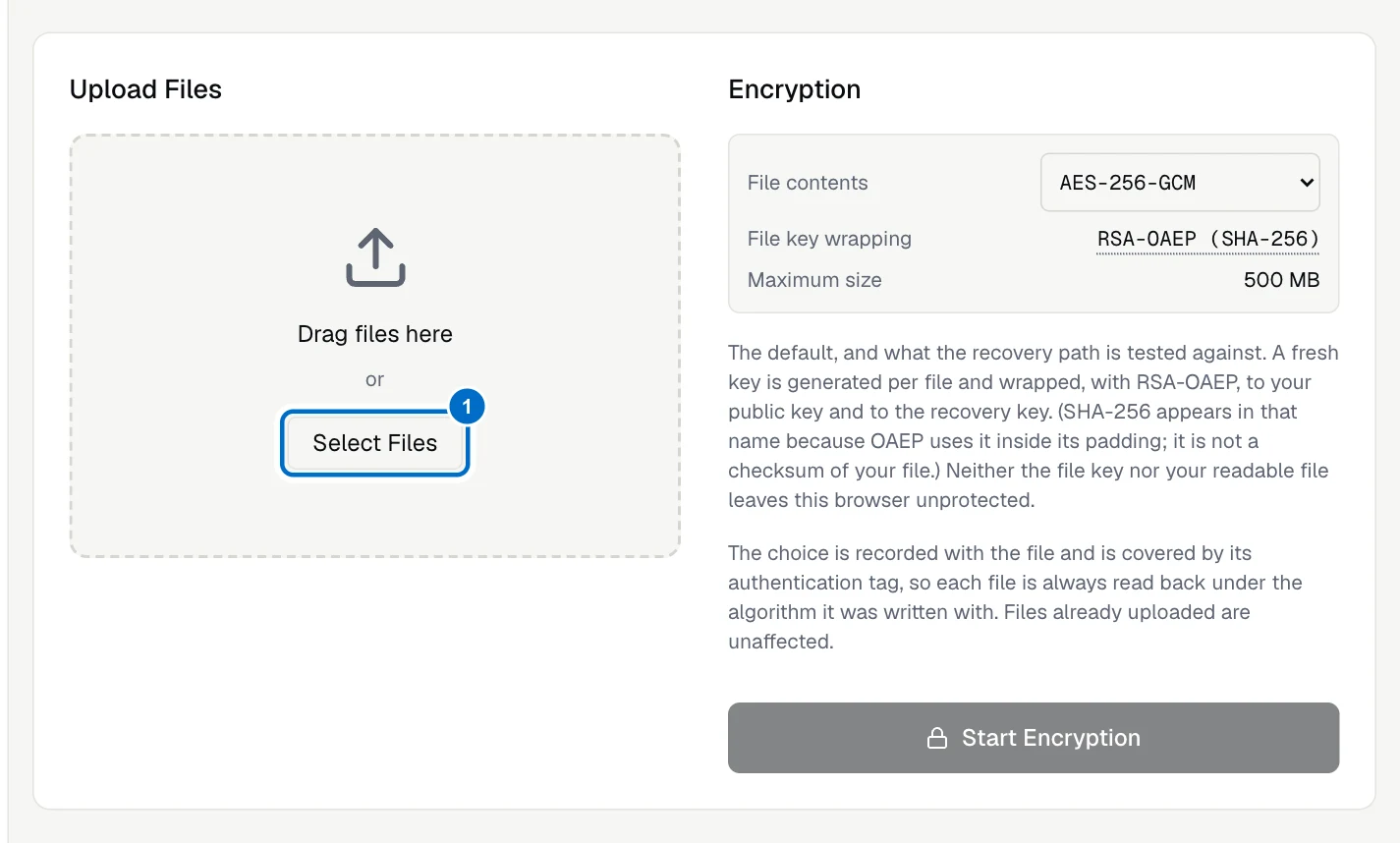 |
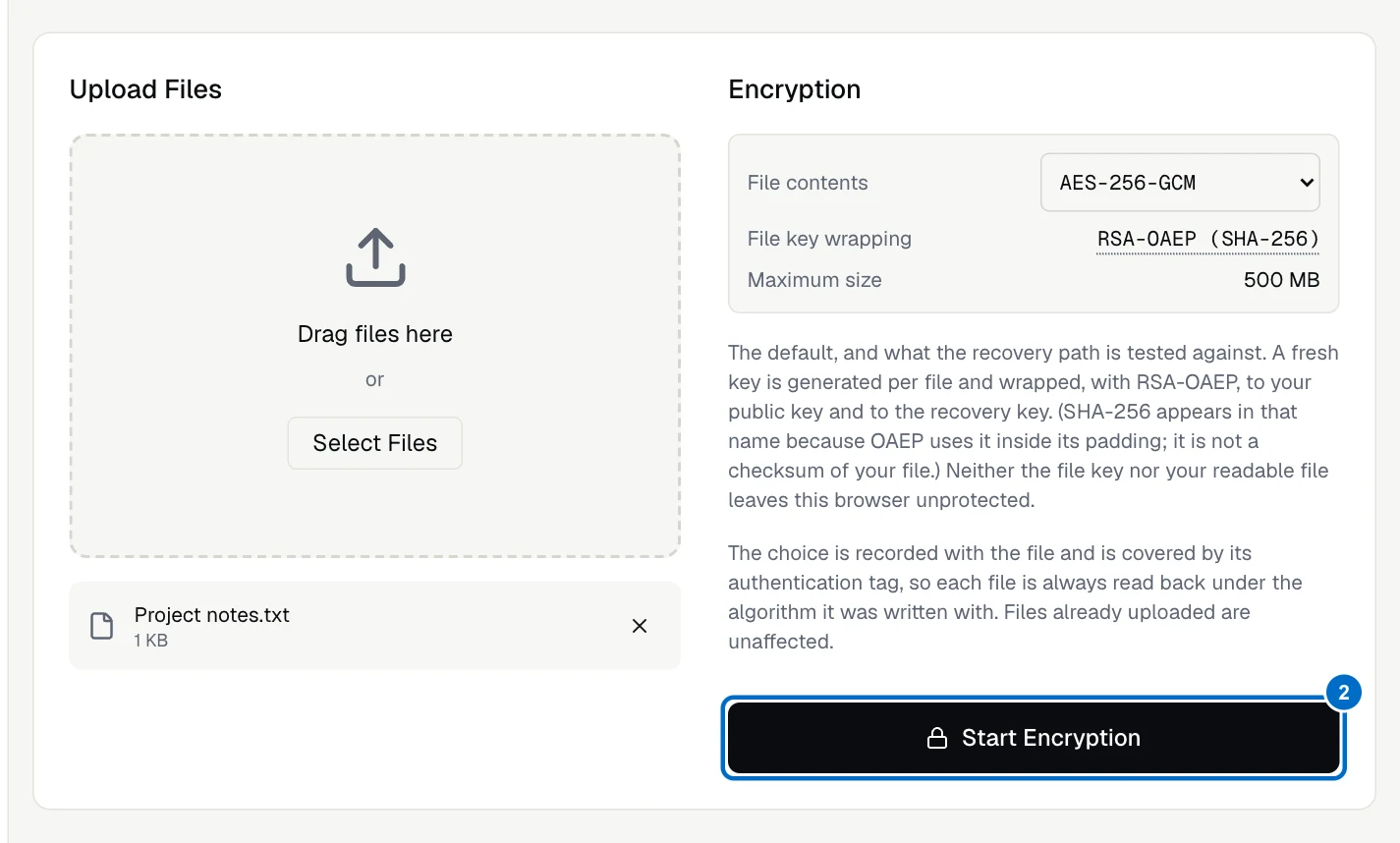 |
| 3. Manage the encrypted file | 4. Share to a checked recipient |
|---|---|
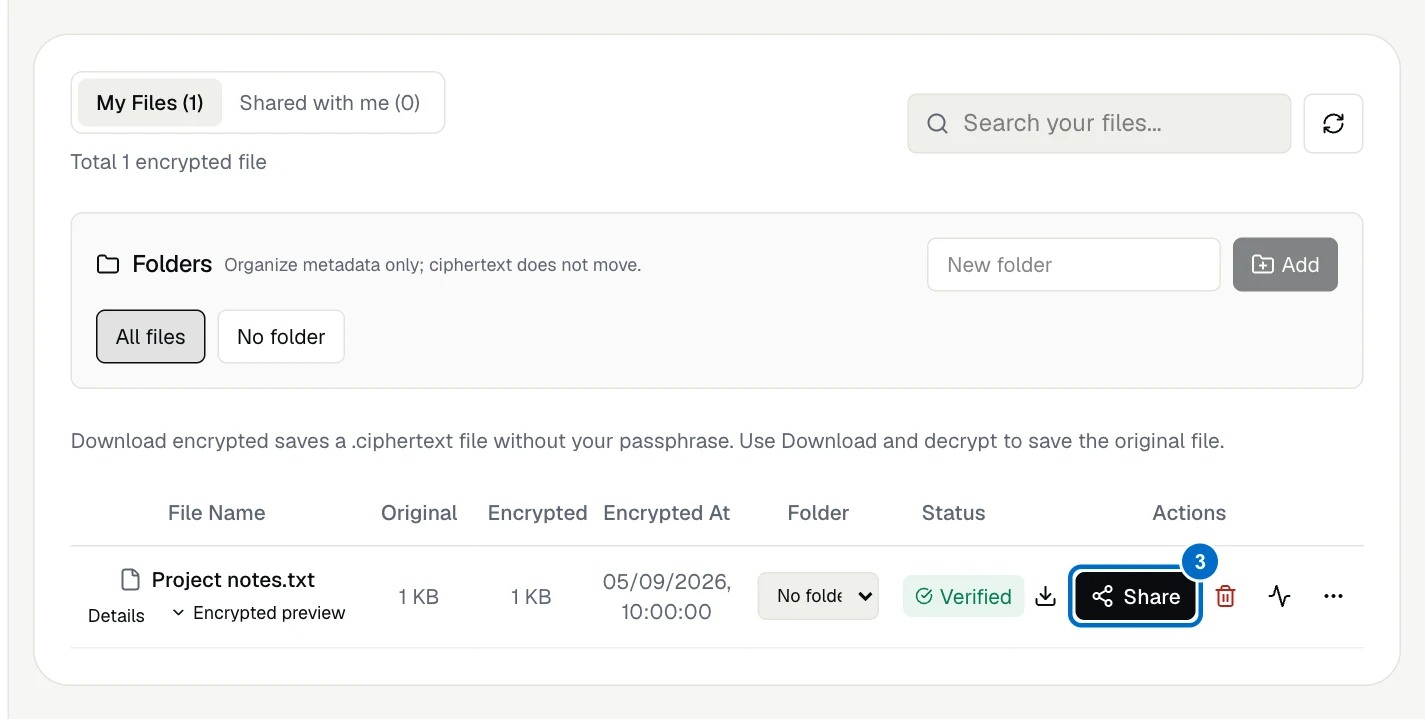 |
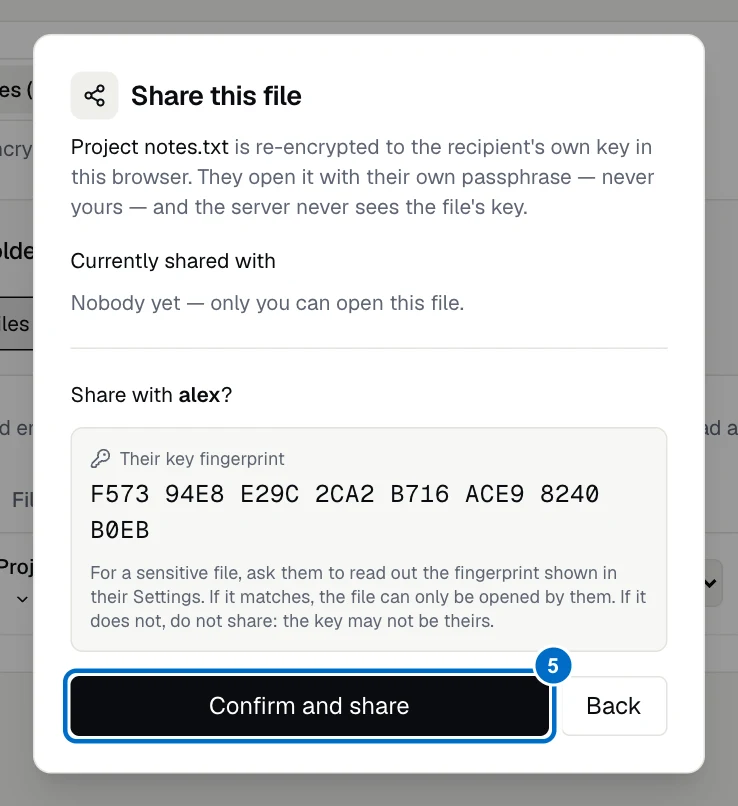 |
| 5. Recipient unlocks locally | 6. Verify and download |
|---|---|
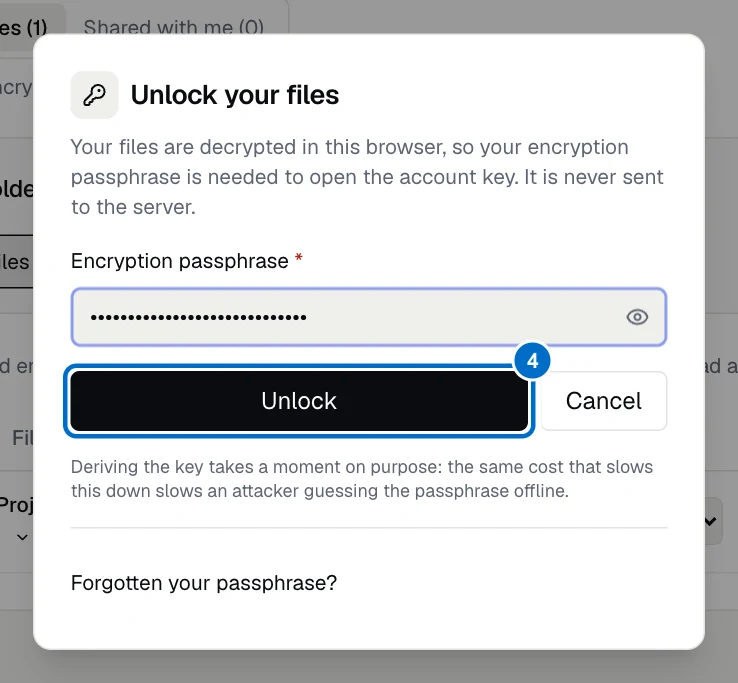 |
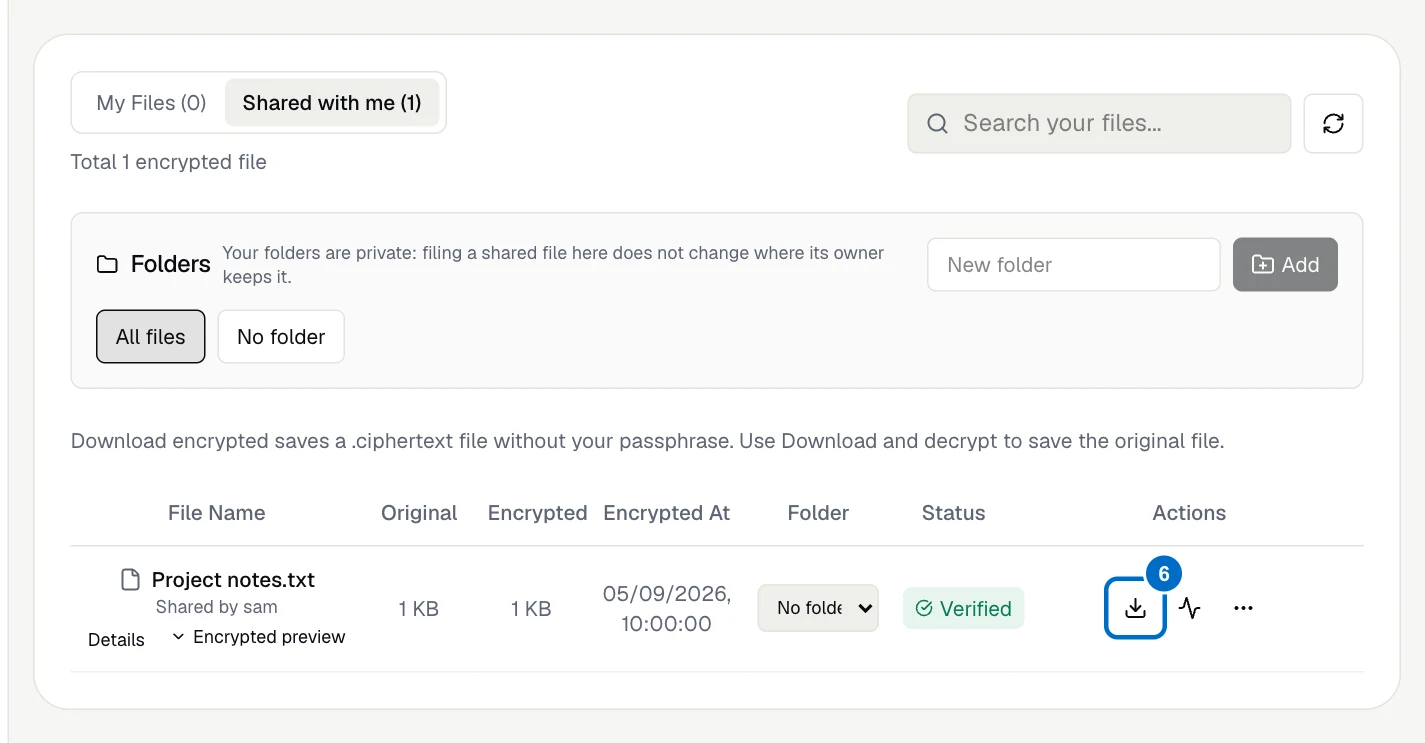 |
The public Help page also uses three freshly re-recorded clips from the redesigned interface:
- How SecureView works — product flow and trust boundary.
- Encrypt and upload — local encryption, sealing and upload.
- Share and open — recipient verification, sharing and local unlock.
See docs/DEMO.md for posters, Chinese walkthrough images and the media manifest.
flowchart LR
U[User Browser<br/>WebCrypto + AEAD] -->|HTTPS| N[Nginx]
N --> F[Vue 3 + TypeScript SPA]
N -->|/api/v1| A[FastAPI]
A --> D[(MySQL 8.4)]
A --> S[(Encrypted Object Storage)]
A --> L[Audit Chain, RBAC, Integrity and Security Agent]
classDef client fill:#dbeafe,stroke:#2563eb,color:#0f172a
classDef server fill:#ede9fe,stroke:#7c3aed,color:#0f172a
classDef data fill:#dcfce7,stroke:#16a34a,color:#0f172a
class U,F client
class N,A,L server
class D,S data
The Vue frontend owns file-content cryptography and account-key handling. The FastAPI backend authenticates and authorises actors, validates requests, runs business transactions, appends audit records and stores encrypted objects and metadata. It does not decrypt user files.
| Area | Technologies |
|---|---|
| Frontend | Vue 3, TypeScript, Vite, WebCrypto |
| Backend | FastAPI, Python, Pydantic, SQLAlchemy, Alembic |
| Database | MySQL 8.4 |
| Cryptography | AES-GCM, AES-GCM-SIV, (X)ChaCha20-Poly1305, RSA-OAEP, Argon2id, SHA-256 |
| Testing | pytest, Vitest, Playwright, custom load testing, OWASP ZAP, pip-audit, npm audit |
| Infrastructure | Linux, Nginx, Docker, systemd, GitHub Actions self-hosted runners |
- Each file receives a fresh browser-generated data-encryption key.
- Authenticated encryption protects both confidentiality and integrity of file content.
- RSA-OAEP with SHA-256 wraps the file key separately for the owner and each authorised recipient.
- Login passwords are one-way hashed with Argon2id on the server.
- The separate encryption passphrase is used in the browser to derive key-encryption material and is never sent to the server.
- A saved private-key file can recover access if the encryption passphrase is forgotten.
- Audit records are hash chained, making later history modification detectable.
- Upload quotas, free-space guards and rate limits reduce storage-abuse risk.
- Because the server stores ciphertext, it cannot inspect shared files for malware; risky executable or macro-capable files therefore trigger recipient warnings.
SecureView is an academic prototype, not a claim of independently audited production security. The public security summary and residual-risk notes are in docs/SECURITY_OVERVIEW.md.
- 503 backend unit tests and 810 frontend tests pass on the current main branch.
- The full backend suite against real MySQL 8.4 contains 633 tests and runs at about 85% branch coverage.
- Live end-to-end tests cover verification-code registration, session refresh and replay rejection, account unlock, all six ciphers, upload/download, sharing/revocation, audit visibility, role denial and account deletion.
- Playwright drives the real browser flow through registration, upload, unlock, download, byte-for-byte comparison, sharing, revocation and logout.
- Concurrency tests target session limits, audit chaining, key rewraps, duplicate shares and recovery races.
- Fault-injection tests exercise failed database commits, storage failures, malformed envelopes and forged signatures.
- Cryptographic vectors are checked against OpenSSL, libsodium and RFC 8452 references.
The staging capacity study on 3–4 October 2026 recorded:
- 22,264 operations.
- 5,094 verified downloads with 0 integrity failures.
- Common file types from 1 MB through 500 MB round-tripped byte-exact.
- No server error up to 50 concurrent users in the measured run.
- A 100-user run exposed a database-pool/thread-pool interaction: failed uploads reached about 80% while CPU averaged only 3%.
- After the fix, the 100-user failure rate dropped from 80% to 0%, throughput improved from 0.33 to 56 operations/second, and the staging re-run completed 102/102 uploads successfully.
- OWASP ZAP baseline scan: 0 FAIL, 8 WARN, 59 PASS, with the reported missing static security headers subsequently fixed in Nginx.
- pip-audit and npm audit: no findings in production dependencies at the recorded scan.
- Tamper drills modify stored ciphertext and verify that download is refused; changing the recorded SHA-256 as well is still rejected by authenticated encryption.
- Encrypted off-server backups are validated by a clean-host restore drill.
More detail: docs/TESTING_AND_PERFORMANCE.md.
As of 6 October 2026, I authored 137 of the project's 158 merged pull requests (145 authored PRs in total) and opened 29 issues.
- Built the load/capacity tool and ran the staging capacity study.
- Diagnosed and fixed the 100-user database-pool failure and two MySQL concurrency deadlocks, with regression coverage.
- Built CI quality gates, the MySQL 8.4 release gate, live end-to-end testing, concurrency/fault-injection coverage and Playwright browser tests.
- Built the isolated tamper drill and live tamper demonstration.
- Added responsive browser checks, layout audits and the later site-wide text audit.
- Ran OWASP ZAP, pip-audit and npm audit and fixed the security-header findings.
- Added AES-256-GCM-SIV and XChaCha20-Poly1305 to the original AES-GCM/ChaCha set.
- Built the Security Agent and its later evidence/de-duplication improvements.
- Built the integrity/recovery pipeline, daily checks and single-file restore view.
- Implemented upload-abuse limits, risky-file warnings and recipient key-fingerprint confirmation.
- Built the Help Assistant, bilingual interface, admin console, account details/login-password reset, file details, encrypted preview and visible encryption-step evidence.
- Implemented earlier core browser flows including download/decryption, recipient re-wrapping, private-key-file unlock, idle relock, session renewal and account deletion.
- Built and maintained guarded automatic deployment of exact CI-passed commits.
- Deployed and hardened Nginx/HTTPS, security headers, rate limiting and fail2ban.
- Added encrypted off-server backups, clean-host restore verification, reconciliation, monitoring and redacted operational evidence.
- Maintained bilingual architecture, security, threat-model, testing, performance and release documentation, plus final-presentation evidence.
- CHANGELOG.md — curated public milestone history.
- docs/README.md — documentation and evidence index.
- docs/DEMO.md — current screenshots, Chinese screenshots and videos.
- docs/SECURITY_OVERVIEW.md — public security model and limitations.
- docs/TESTING_AND_PERFORMANCE.md — test strategy and measured performance.
Visit https://secureview.tech and include the https:// prefix.
The main implementation repository remains private while the university team project is under active assessment. This portfolio repository intentionally excludes private source code, credentials, test-account secrets, private-key material and internal deployment details.
More implementation material may be published later when academic and team requirements allow.
Project: SecureView · Institution: Monash University Malaysia · Units: FIT3161 / FIT3162 · Team: MCS21 · Team size: Four students