



A production-style end-to-end Restaurant Analytics Platform built on Azure Databricks using the Medallion Architecture, Delta Lake, Unity Catalog, Lakeflow Declarative Pipelines, and Azure Event Hub for real-time data ingestion.
Modern restaurants generate enormous volumes of operational data every day—from customer orders and menu selections to restaurant reviews and customer interactions.
Simply storing this data is not enough.
Businesses need an intelligent analytics platform capable of:
- Processing streaming and batch data
- Maintaining high-quality datasets
- Performing scalable transformations
- Building analytical data models
- Delivering business-ready insights
This project demonstrates how these challenges can be solved using the modern Databricks Lakehouse Platform.
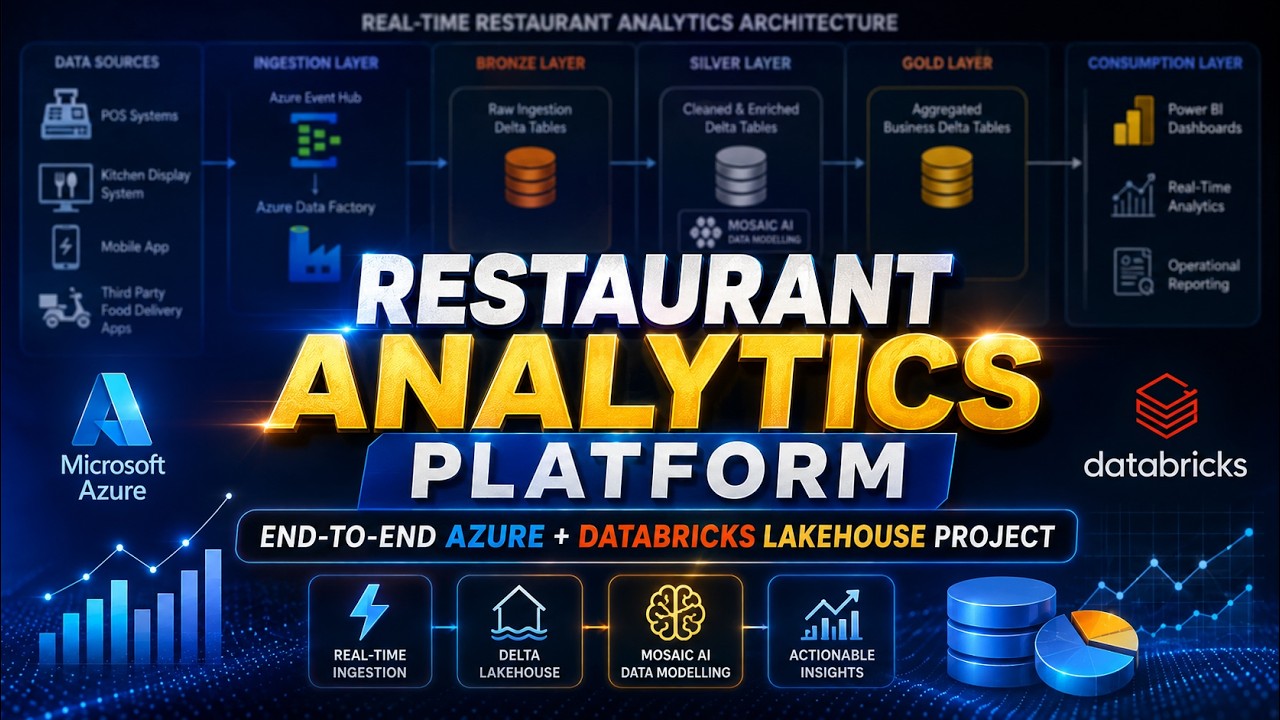
The pipeline ingests raw restaurant data, validates it, transforms it through the Bronze, Silver, and Gold layers, and produces curated datasets that power business dashboards and analytical reporting.
Want to see the project in action?
✅ End-to-End Lakehouse Architecture
✅ Medallion Architecture (Bronze → Silver → Gold)
✅ Unity Catalog Governance
✅ Lakeflow Declarative Pipelines
✅ Delta Lake Storage
✅ Structured Streaming
✅ Azure Event Hub Integration
✅ Data Quality Expectations
✅ Real-Time Order Processing
✅ Customer 360 Analytics
✅ Restaurant Performance Analytics
✅ Sales Summary Aggregations

The platform follows the industry-standard Medallion Architecture, where data progressively becomes cleaner, richer, and more business-friendly.
                        Azure Event Hub
                              │
                              ▼
                    Lakeflow Pipeline
                              │
                Bronze (Raw Ingestion)
                              │
                              ▼
              Silver (Validated & Cleaned)
                              │
                              ▼
          Gold (Business Ready Data Models)
                              │
                              ▼
                   Dashboards & Analytics
Databricks-RestaurantAnalyticsPlatform

│
├── Data
│   ├── customers.csv
│   ├── restaurants.csv
│   ├── menu_items.csv
│   ├── customer_reviews.csv
│   ├── historical_orders.csv
│
├── Data Ingestion
│   ├── Ingestion_to_Bronze.ipynb
│   └── Ingestion_to_Silver.ipynb
│
├── EventHubDataIngestion
│   ├── transformations
│   └── explorations
│
├── Silver_Level_Transformations
│   ├── transformations
│   └── explorations
│
├── Gold_Level_Transformations
│   ├── transformations
│   └── explorations
│
├── Dashboard Images
│
├── project_architecture.png
│
└── README.md
| Layer | Technology |
|---|---|
| Cloud Platform | Azure |
| Data Platform | Databricks |
| Storage | Delta Lake |
| Data Processing | PySpark |
| Streaming | Structured Streaming |
| Messaging | Azure Event Hub |
| Governance | Unity Catalog |
| Pipeline | Lakeflow Declarative Pipelines |
| Language | Python |
| SQL Engine | Spark SQL |
The project processes both historical and streaming datasets.
- Customers
- Restaurants
- Menu Items
- Customer Reviews
- Historical Orders
Restaurant Orders are streamed through Azure Event Hub, simulating a real-world online ordering system.
The Bronze layer serves as the raw landing zone.
- Ingest streaming events
- Preserve original data
- Minimal transformations
- Schema enforcement
- Store immutable raw records
Streaming ingestion is implemented using:
- Azure Event Hub
- Kafka API
- Structured Streaming
- Lakeflow Declarative Pipelines
Example Bronze table:
01_bronze.orders
The Silver layer performs data cleansing, enrichment, and validation.
Implemented transformations include:
- Timestamp conversion
- Date extraction
- Weekend identification
- Hour extraction
- JSON parsing
- Item count calculation
- Business rule validation
Data quality expectations ensure records with invalid values are automatically removed.
Examples include:
- Null Order IDs
- Invalid Order Status
- Invalid Payment Method
- Negative Revenue
- Missing Customer IDs
Example Silver tables
02_silver.fact_orders

02_silver.fact_order_items

02_silver.fact_reviews
The Gold layer contains business-ready datasets designed for reporting and dashboarding.
Current Gold models include:
Daily KPIs including
- Total Revenue
- Average Order Value
- Total Orders
- Delivery Orders
- Dine-In Orders
- Takeaway Orders
- Active Restaurants
- Unique Customers
Customer-centric analytical dataset including
- Customer Profile
- Lifetime Spend
- Ordering Behaviour
- Customer Segmentation
Aggregated review metrics including
- Average Rating
- Total Reviews
- Restaurant Performance
The project uses Lakeflow Declarative Pipelines to define scalable data pipelines.
Benefits include:
- Simplified ETL
- Automatic dependency management
- Incremental processing
- Built-in monitoring
- Streaming support
- Declarative transformations
Data quality is enforced directly inside the pipeline using expectations.
Examples include validating:
- Order IDs
- Customer IDs
- Restaurant IDs
- Order Status
- Payment Method
- Positive Revenue
- Valid Item Count
Invalid records are automatically dropped before reaching downstream layers.
The platform enables several analytical use cases.
- Daily Revenue
- Revenue Trend
- Average Basket Size
- Peak Ordering Hours
- Customer Lifetime Value
- Repeat Customers
- Customer Behaviour
- Spending Patterns
- Restaurant Ratings
- Order Volume
- Revenue Contribution
- Restaurant Performance
The repository includes sample dashboards demonstrating:
- Restaurant Analytics
- Customer Analytics
- Customer Reviews
- Sales Performance
Dashboard assets are available under:
Dashboard Images/
-
Create an Azure Databricks Workspace
-
Configure Unity Catalog
-
Create Catalogs and Schemas
-
Upload source datasets
-
Configure Azure Event Hub
-
Deploy Lakeflow Pipelines
-
Execute Bronze Layer
-
Execute Silver Layer
-
Execute Gold Layer
-
Connect Power BI or Databricks Dashboards
Through this project, I gained practical experience with:
- Azure Databricks
- Unity Catalog
- Lakehouse Architecture
- Delta Lake
- Structured Streaming
- Azure Event Hub
- Data Quality Expectations
- Lakeflow Declarative Pipelines
- PySpark Transformations
- Real-time Analytics
- CI/CD using Azure DevOps
- Infrastructure as Code with Terraform
- Workflow orchestration
- Data lineage visualization
- Machine Learning for demand forecasting
- Customer recommendation engine
- Real-time alerting
- Data observability
- Cost optimization dashboards
This project was built by following and learning from the excellent End-to-End Databricks Project by Afaq Ahmed.
The implementation has been recreated, explored, and documented as a hands-on learning project to deepen my understanding of modern Azure Data Engineering concepts and Databricks best practices.
Special thanks to Afaq Ahmed for creating practical and industry-oriented learning content.
Chethan Prabhas
Azure Data Engineer | Databricks | PySpark | Azure Data Factory | SQL
If you found this repository useful, consider giving it a ⭐ to support the project.