





A validation layer for AI-assisted biological curation: let models do the routine work, and send experts only the records that need them.
LLMs and agents now extract claims from papers, cite the literature and annotate single-cell clusters. Their output looks right, and it often is not. Some typical errors:
- a Cell Ontology ID that names a different cell type;
- a real PMID that belongs to an unrelated paper;
- a quote that appears nowhere in the paper.
Bioevidence checks every AI-produced record against pinned sources and reference releases, and decides, for each intended use, whether it is admitted, needs review, or is rejected. Errors the model can fix go back to it with the exact correction; findings that need judgment go to a person. Every claim below is measured on real data with six models from Anthropic, OpenAI and Google.
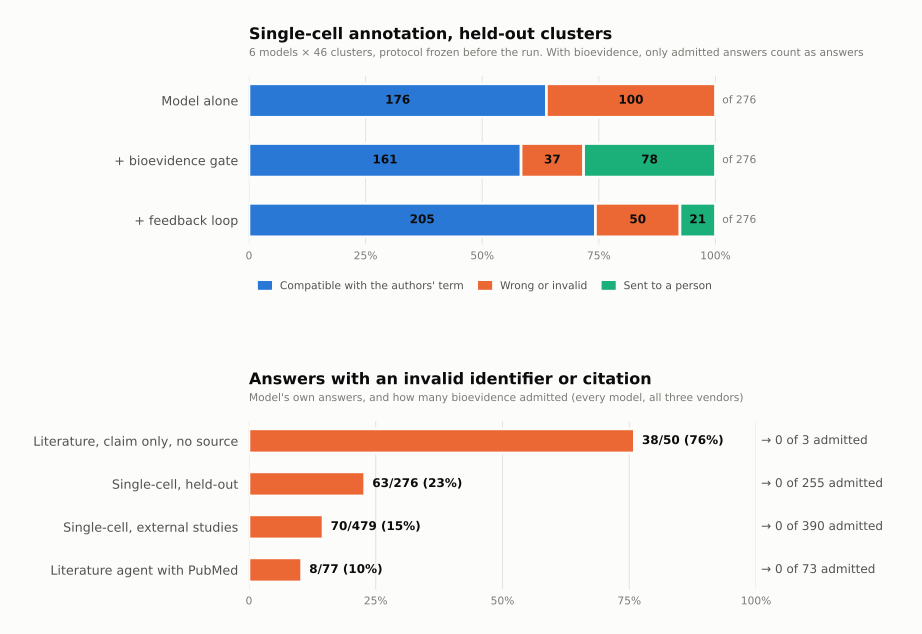
| Experiment | The model alone | With bioevidence |
|---|---|---|
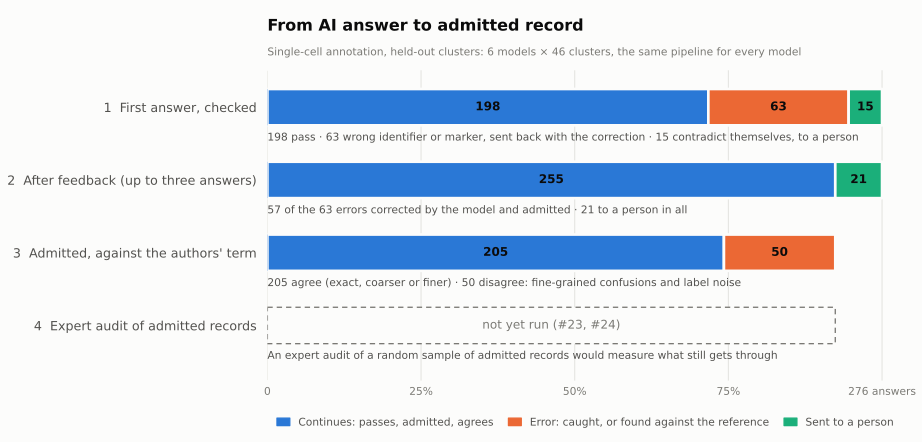
| Single-cell cell-type annotation: 6 models × 46 held-out clusters, protocol frozen before the run | 62 of 276 answers (22%) carry a Cell Ontology ID that does not match its label, e.g. "Paneth cell" filed under the ID of a pigment cell | No such answer admitted. In the feedback loop, answers compatible with the authors' term rise from 176 to 205, wrong or invalid fall from 36% of answers to 20% of those admitted, and 8% go to a person |
| Literature claims without a source: 6 models × 18 CIViC claims | 38 of 50 answers cite an invalid paper or quote; 28 of 66 citations are real PMIDs of unrelated papers | 3 answers admitted, all with verified citations and the right decision |
| Literature agent with PubMed tools: 108 episodes | 8 of 77 first answers misquote their papers | 0 of 73 admitted answers carry an invalid citation; feedback rescues answers a plain gate would lose |
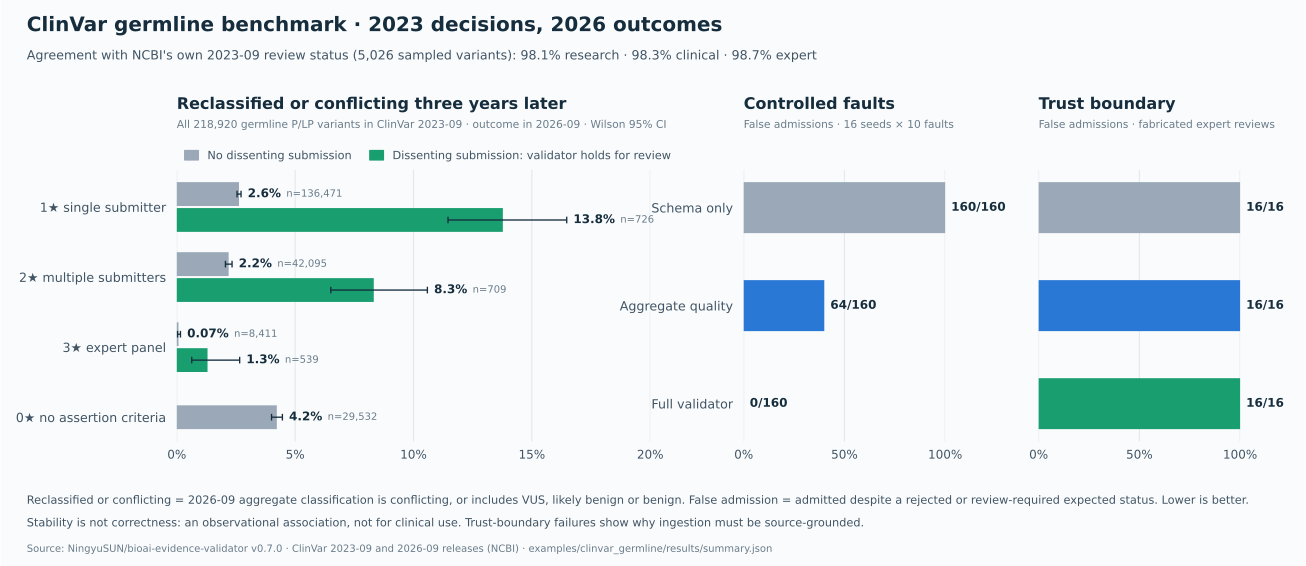
| ClinVar germline classifications: 5,026 variants, 2023 → 2026 | Schema-only checks admit 160 of 160 injected faults | 0 of 160 admitted; variants held back for a dissenting submission were 4–5× more likely to be reclassified three years later |
What it cannot do, also measured:
- Semantic errors with valid identifiers and real evidence still get through. Examples are a memory T cell called naive, or an ILC3 called a Th17 cell: 20% of admitted single-cell annotations disagree with the authors' term, part of it label noise.
- One check failed external validation. A check built from Cell Ontology marker definitions, with thresholds set on development data, flagged errors no better than chance on six new studies. Fed back to the models, it turned 15 correct answers into wrong ones. The check is kept as experimental, and the cause (protein definitions that do not hold for transcripts) is documented.
Full protocols and numbers: LLM benchmark · single-cell case · ClinVar case.
The agent benchmark runs the whole chain with every model:
- the harness, not the model's CLI, executes the tools, so each step is logged;
- each model reply must match a JSON Schema;
- each submission is validated by bioevidence before anything is admitted.
sequenceDiagram
    participant H as Harness
    participant M as Model (Claude / GPT / Gemini CLI)
    participant T as Tools (PubMed, pinned papers)
    participant B as bioevidence
    H->>M: claim + tool list + JSON Schema for the reply
    M-->>H: {"action": "search", "query": ...}
    H->>T: esearch + efetch (cached, rate-limited)
    T-->>H: up to 8 hits: PMID, title, abstract snippet
    M-->>H: {"action": "read", "pmid": ...}
    H->>T: resolve, pin full text or abstract by SHA-256
    M-->>H: {"action": "submit", "decision": ..., "citations": [{pmid, title, quote, stance}]}
    H->>B: record built from the submission, validated with grounders
    alt admitted
        B-->>H: admitted, report with hashes
    else fixable finding
        B-->>H: reasons (e.g. "citation 1: The quote does not appear in the cited paper.")
        H->>M: the same task, with the reasons
    else needs judgment
        B-->>H: to a person (conflicting evidence, policy)
    end
A real run from the committed results: Claude Haiku 4.5, asked whether VHL mutation predicts response to anti-VEGF antibodies in renal cell carcinoma.
| Step | Model output (schema-validated JSON) | Harness and bioevidence |
|---|---|---|
| 1 | search: "VHL mutation renal cell carcinoma anti-VEGF response" |
PubMed returns up to 8 hits with titles and abstract snippets |
| 2 | read: PMID 28103578 |
The paper is resolved and pinned by SHA-256; its text is returned |
| 3 | submit: decision does_not_support, one citation with a 67-word quote |
Rejected. BEV017: the quote does not appear in the cited paper. BEV020: no verified quote, as the profile requires. The reasons go back to the model |
| 4 | submit: the same decision with three shorter quotes from the same paper |
All three are found in the pinned text, so the record is admitted. Its decision matches CIViC's |
The same loop corrects identifiers in single-cell annotation. Claude Haiku 4.5 labeled a pancreatic cluster
"pancreatic delta cell" but gave the ID CL:0002335, which is a brown preadipocyte. The feedback it received:
object label: The label 'pancreatic delta cell' is not the name of CL:0002335 ('brown preadipocyte'). 'pancreatic delta cell' is the name of CL:0000173 (pancreatic D cell).
Its second answer, CL:0000173, was admitted and is exactly the authors' annotation.
Across all 276 held-out annotations, stage by stage:
Failure handling, each in the code and exercised in the runs:
| Failure | Detected by | Handling |
|---|---|---|
| Malformed reply, or one that violates the schema | JSON Schema enforced by the CLI, then check_step / check_answer |
One retry; then the step is logged as failed and the episode continues |
| The CLI uses its own tools (web, shell) | Tools are disabled where the CLI allows; otherwise tool events in its output stream | The answer is discarded and the call retried; the prompt also forbids tools |
| CLI error, timeout, no structured output | Subprocess timeout and output parsers | Logged per step and kept in the results (4 of 601 steps in the agent pilot) |
| PubMed rate limits, server errors | Library.fetch |
Exponential backoff on 429 and 5xx, a response cache, a 100 MB download cap |
| Wrong paper, retracted paper, quote not in the paper | LiteratureGrounder (BEV016, BEV017, BEV019) |
The reason goes back to the model; at most three submissions |
| ID of another term, obsolete term, gene alias | OntologyGrounder, GeneGrounder (BEV017, BEV023, BEV024) |
The reason goes back, naming the correct identifier |
| The model's own evidence contradicts its answer | BEV004 | Sent to a person; not fed back, so the model is never asked to hide it. Flagged answers were wrong 82% of the time vs 33% (routing evidence) |
| A revision drops evidence that was verified | feedback.carry |
The verified evidence is carried into the revision |
| Still not admitted after the last round | feedback.revise |
Sent to a person |
| Admitted but wrong | A seeded random audit (bioevidence review audit-sample, audit-score) |
Each route's error rate with an exact upper bound; a dry run shows the held-out route misses a 5% target |
| A long batch is interrupted | One file per episode | A rerun skips finished episodes (used when a 486-episode run hit a time limit) |
flowchart LR
    A["AI output<br/>(LLM or agent)"] --> R["Evidence record<br/>claim + sources + evidence"]
    R --> P["Profile rules<br/>per intended use"]
    R --> G["Grounders<br/>check against pinned sources"]
    P --> D{"Decision<br/>per use"}
    G --> D
    D -->|admitted| K["Knowledge base /<br/>training set"]
    D -->|fixable error| F["Feedback to the model<br/>with the exact correction"]
    F --> A
    D -->|needs judgment| H["Expert review"]
    D --> L["Audit report<br/>findings, versions, hashes"]
-
Records: a claim (subject, predicate, object, scope) with the sources it rests on and typed evidence items. They are validated against a LinkML schema.
-
Profiles: each profile states, per use, which evidence a claim needs before it is admitted. For example, LLM-extracted evidence may be enough for a research summary, while a knowledge base requires a human's acceptance. Profiles are YAML, so a new domain needs no engine changes.
-
Grounders: they recompute what a record only asserts from pinned, content-addressed snapshots:
Grounder Checks Literature PMID/DOI resolution, retraction, title, and every quote against open full text or the abstract Ontology the term exists, is current, matches its label and is of the right kind (e.g. a cell type) Genes / variants HGNC approved symbols, previous symbols and aliases; HGVS form, RefSeq version, genome build Tables a cited data row exists with the values claimed (e.g. a marker gene of this cluster) Reference resources a curated reference contradicts the claim (review only) Ontology definitions measurements contradict a marker the claimed term is defined by (experimental) -
Feedback loop:
feedback.revisewraps any model or agent.- Fixable findings go back as precise reasons.
- Conflicts and policy decisions go to a person unchanged.
- Verified evidence cannot be withdrawn in a revision, so an agent cannot drop the evidence against its own answer.
-
Audit: every report records the input, schema and profile hashes and versions. There are 26 documented rule codes, each with a fixed severity.
- Rigorous evaluation of LLMs and agents.
- Six models from three vendors, called through their CLIs with structured output, plus a tool-using agent with PubMed access.
- Protocols are designed on pilot data and committed to git before the held-out and external splits are run.
- Scoring is ontology-aware, with Wilson intervals.
- Negative results are reported, including the run where a new check made things worse.
- Biological data engineering.
- Single-cell marker statistics computed from raw counts (CELLxGENE).
- The Cell Ontology, including its disjointness axioms and logical definitions, HGNC, NCBI assemblies, ClinVar submissions, CIViC evidence and PMC JATS full text.
- All sources are pinned by SHA-256, with licences and attribution.
- Production-quality software.
- A typed Python package on PyPI, with CLI exit codes for pipelines and a GitHub Action for CI.
- Test coverage around 98%, with CI on Linux and Windows for Python 3.11–3.14.
- A documentation site, and byte-for-byte replay of every committed benchmark table.
- Designing for trust, not only accuracy.
- Decisions are made per intended use, with a measured trust boundary (controlled faults and forged sources).
- Only facts are fed back to a model; anything that needs judgment goes to a person.
pip install bioai-evidence-validator
bioevidence validate examples/literature_claim/llm_only.json --profile literature-claim   # exit 2: review required
From version 0.8.0 the package also includes the literature, ontology, gene, variant, table and reference grounders, and the feedback loop. For example, to check a cell-type annotation against a pinned Cell Ontology release and the HGNC gene set:
bioevidence validate record.json --ontology cl.obo --term-root cell_type=CL:0000000 --genes hgnc_complete_set.txtWrap a model in the feedback loop:
from pathlib import Path

from bioevidence_validator.engine import RecordValidator
from bioevidence_validator.feedback import revise
from bioevidence_validator.identifiers import GeneGrounder, Genes, Ontology, OntologyGrounder

validator = RecordValidator(profile="general", grounders=[
    OntologyGrounder([Ontology.from_obo(Path("cl.obo").read_bytes())], roots={"cell_type": ["CL:0000000"]}),
    GeneGrounder(Genes.from_hgnc(Path("hgnc_complete_set.txt").read_bytes())),
])

def propose(feedback: list[str]) -> dict | None:
    """Ask your model for a record; on later rounds, include the feedback in the prompt."""
    ...

attempts = revise(propose, validator, rounds=3)
print(attempts[-1].report["overall_status"])   # admitted, review_required or rejected
Exit codes: 0 admitted, 1 rejected, 2 review required, 3 input or configuration error.
To check records in a pull request, use the GitHub Action:
- uses: NingyuSUN/bioai-evidence-validator@v0.8.0
  with:
    files: records/**/*.yaml
    format: draft
    profile: literature-claim
    fail-on: review
More: draft format (state each fact once, build the full record) · create a profile · engineering contract and rule codes · documentation site.
| Case | Data | What it shows |
|---|---|---|
| Single-cell cell-type annotation | 12 CELLxGENE datasets (151 clusters), Cell Ontology, HGNC, HuBMAP ASCT+B | Identifier hallucination caught for every model; a feedback loop that improves annotations; a pre-registered external test of a new check that failed |
| LLM literature benchmark | CIViC claims, PMC open-access papers, six models | Invented citations blocked; an agent loop with stances and a "conflicting" outcome; semantic checks |
| CIViC literature grounding | CC BY / CC0 full texts and retracted papers, pinned from PMC | Quotes, titles and retractions verified against pinned bytes |
| ClinVar germline, three years later | 5,026 variants from the 2023-09 release, followed to 2026-09 | The profile reproduces NCBI's review status in 98–99% of decisions; held-back variants were less stable; a closed trust boundary |
| VBO canine name mapping | A pinned public ontology release | 0 of 160 controlled faults and 0 of 48 forged sources admitted |
uv run --frozen --with matplotlib==3.11.2 python tools/reproduce.pyOne command regenerates every committed benchmark table, summary and figure, offline, in about three minutes, and compares each with the repository byte for byte (text files with line endings normalised). It runs 20 steps, also run in CI on every change:
- the three real-data cases;
- ten LLM-benchmark result sets;
- the routing evidence and the audit dry run;
- the task files and the error taxonomy;
- the figures.
Model calls, agent runs and downloads are not repeated. What they produced is committed and pinned by
SHA-256: model answers, agent episodes, the verification of cited papers, and source snapshots. --write updates the
committed files and --list shows the steps.
- Admission is not truth. It means the record meets the selected profile: its evidence exists in the pinned sources and satisfies the use's rules. It does not mean the biological claim is true.
- The references are curators' and authors' labels, not independent expert labels. A blinded expert-review kit is ready (#23).
- Sample sizes are small. The literature benchmarks are pilot-scale (18 claims). Each single-cell split was run once.
- Not for clinical use.
What is and is not established, in the structure of FDA's draft AI credibility framework (question of interest, context of use, model risk, credibility evidence, adequacy): the validation dossier.
Tracked in the AI validation roadmap (#26):
- expert review of the benchmark cases (#23);
- an expert audit of admitted records with
bioevidence review audit-sampleandaudit-score, which bound the error rate of what still gets through. The tool and a dry run are done (#24); the audit needs experts. - the validation dossier, structured after FDA's draft AI credibility framework, states what is established and what is not (#25).
Bug reports, domain profiles and new benchmarks are welcome. See
CONTRIBUTING.md and
issues labelled good first issue;
report security problems as described in SECURITY.md.
To cite this toolkit, use CITATION.cff
(GitHub's "Cite this repository" button).
Author: Ningyu Sun (@NingyuSUN) · Changelog · Standards alignment · Error taxonomy · Design case study · Apache-2.0