
ICML 2026






Zihao Wang1
1Laplace Lab · Department of Computer Science, University of Tennessee, Chattanooga, US
Correspondence: 1stname[.]lastname@tennessee.edu
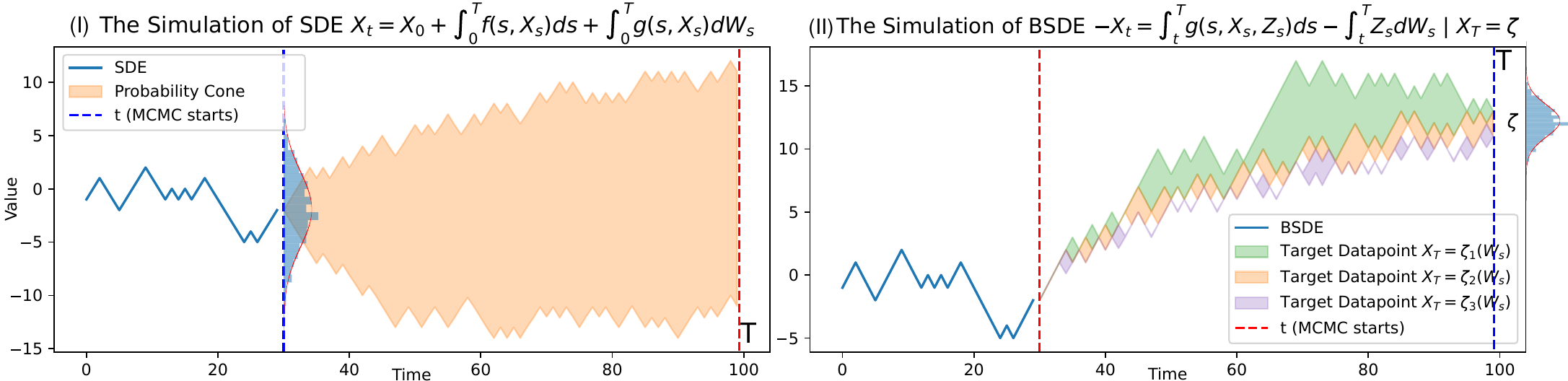
Pretrained score-based diffusion models are powerful unconditional priors, but inverse problems require outputs that satisfy a measurement or physics constraint. Common approaches inject guidance, penalties, or projections throughout sampling. This framework instead expresses feasibility where it is required: at the terminal state.
Given frozen stochastic prior dynamics and a task-defined terminal map, the framework learns the adapted BSDE pair that connects a prior-space anchor to the required endpoint:
The learned value
Framework, not a CT package. Sparse-view CT is one evaluation in the paper. The released core has no CT, Radon-transform, image-loading, or dataset dependency. A new application supplies only its prior dynamics, terminal map, and control architecture.
| Conventional guidance | BSDE Diffusion |
|---|---|
| Modifies the sampling path with task-specific penalties | Keeps the pretrained prior dynamics unchanged |
| Requires a guidance or projection schedule | Places task information in one terminal map |
| May finish outside the feasible set | Encodes endpoint feasibility by construction |
| Often couples solver code to one modality | Exposes a small, modality-agnostic interface |
flowchart LR
    A[Pretrained Score-SDE] -->|drift b and diffusion σ| B[Associated BSDE]
    C[Observation y] --> D[Terminal map Ψ]
    E[Forward operator A] --> D
    D -->|terminal requirement| B
    F[Control network Z] --> B
    B --> G[Recovered anchor Y₀]
    G --> H[Feasible solution]
    G --> I[Neighborhood samples]
The reusable core has four extension points:
| Component | Contract | Owned by |
|---|---|---|
| Prior drift | drift(time, state) -> Tensor |
Application |
| Prior diffusion | diffusion(time, state) -> Tensor |
Application |
| Terminal map | terminal(state) -> Tensor |
Application |
| Adapted control | control(time, state) -> Tensor |
Application |
AssociatedBSDE validates the problem definition. DeepBSDESolver performs the coupled Euler-Maruyama rollout and minimizes the terminal mismatch. The included TimeConditionedMLP is a lightweight reference control for vector-valued problems; structured data can use any compatible PyTorch module.
Python 3.10 or newer is required. Install the PyTorch build appropriate for your hardware, then install the framework:
git clone https://github.com/LaplaceLab/BSDE-Diffusion.git
cd BSDE-Diffusion

python -m venv .venv
source .venv/bin/activate
pip install --upgrade pip
pip install -e .
For development and verification:
pip install -e '.[dev]'
pytest -q
ruff check .The following is a complete terminal-conditioned inverse problem. Replace the simple prior and terminal map with application-specific implementations while preserving the same solver interface.
import torch

from bsde_diffusion import (
    AssociatedBSDE,
    SolverConfig,
    TimeConditionedMLP,
    solve_associated_bsde,
)

device = torch.device("cuda" if torch.cuda.is_available() else "cpu")
dtype = torch.float32

# One shared prior-space anchor. The first dimension is the batch dimension.
initial_state = torch.zeros(1, 16, device=device, dtype=dtype)
observation = torch.ones_like(initial_state)


def prior_drift(time, state):
    """Replace with the drift induced by a frozen Score-SDE prior."""
    return torch.zeros_like(state)


def prior_diffusion(time, state):
    """Diagonal diffusion; scalar or broadcastable outputs are also valid."""
    return torch.full_like(state, 0.2)


def terminal_map(state):
    """Replace with decode -> enforce measurement -> encode."""
    return observation.expand_as(state)


problem = AssociatedBSDE(
    initial_state=initial_state,
    time_grid=torch.linspace(0.0, 1.0, 33, device=device, dtype=dtype),
    drift=prior_drift,
    diffusion=prior_diffusion,
    terminal=terminal_map,
)

control = TimeConditionedMLP(
    event_shape=initial_state.shape[1:],
    hidden_features=128,
    depth=3,
).to(device)

solution = solve_associated_bsde(
    problem,
    control,
    SolverConfig(
        iterations=1_000,
        batch_size=32,
        learning_rate=3e-4,
        gradient_clip=1.0,
    ),
)

print("terminal loss:", solution.final_loss)
recovered_anchor = solution.initial_valueWrap the pretrained stochastic prior as two callables:
prior.eval()
for parameter in prior.parameters():
    parameter.requires_grad_(False)


def drift(time, state):
    return prior.drift(state, time)


def diffusion(time, state):
    return prior.diffusion(state, time)
The framework intentionally does not depend on a particular checkpoint format, scheduler, or model library.
When measurement and prior spaces differ, use a decode-enforce-encode composition:
def terminal(state):
    signal = decode(state)
    feasible_signal = enforce_measurement(signal, observation)
    return encode(feasible_signal)
enforce_measurement may be analytic, iterative, linear, or nonlinear. It must return a deterministic, shape-preserving terminal value for the fixed observation used in that solve.
The control estimates the martingale integrand TimeConditionedMLP for vectors and small tensors. For images, volumes, graphs, or time series, supply a compact time-conditioned network appropriate to that structure.
Always report both the BSDE terminal mismatch and a domain-level residual such as
A plausible-looking output alone is not evidence that the inverse problem has been solved.
| Symbol | Purpose |
|---|---|
AssociatedBSDE |
Defines and validates the stochastic prior and terminal-value problem |
DeepBSDESolver |
Learns the initial value and adapted control through Monte Carlo rollouts |
SolverConfig |
Configures iterations, batch size, learning rate, and gradient clipping |
BSDESolution |
Returns the recovered anchor and terminal-loss history |
TimeConditionedMLP |
Reference control network for vector-valued states |
solve_associated_bsde |
One-call solver construction and optimization |
This repository includes an Agent Skill that teaches a coding agent how to connect a new prior, implement a terminal map, choose a control network, validate feasibility, and keep application artifacts outside the framework.
Example request:
Use the bsde-inverse-problem skill in this repository to adapt BSDE Diffusion
to my inverse problem. Keep the pretrained prior frozen, place all observation
information in the terminal map, add a domain-level feasibility test, and do
not add datasets, checkpoints, or generated outputs to the framework package.
The release is checked with CPU-compatible unit tests covering:
- arbitrary tensor event shapes;
- problem and time-grid validation;
- terminal shape preservation;
- Deep-BSDE rollout shape consistency;
- convergence on a deterministic terminal-value problem.
Run the complete release checks with:
pytest -q
ruff check .
python -m buildThis repository intentionally contains only the reusable framework, its tests, package metadata, and documentation. It excludes datasets, model weights, checkpoints, generated samples, experiment outputs, medical data, and modality-specific reconstruction pipelines.
If this framework contributes to your research, please cite:
@inproceedings{wang2026backward,
  title     = {Backward SDEs-based Diffusion for Physics-Constrained Generation},
  author    = {Wang, Zihao},
  booktitle = {Proceedings of the 43rd International Conference on Machine Learning},
  series    = {Proceedings of Machine Learning Research},
  volume    = {306},
  publisher = {PMLR},
  year      = {2026}
}- Project website: https://laplacelab.github.io/BSDEDiffusion/
- Paper: https://laplacelab.github.io/BSDEDiffusion/paper.pdf
- Lab: https://laplace.center